
 Facebook
 X
X
 Pinterest
 Copy Link
The 10-year Treasury just hit 4.991%. The 30-year hit 5.361%.
Both are multi-decade highs, the 10 year hasn’t been here since 2007, the 30 year since 2004. And this is big news, no doubt.

If you’re sitting on cash or a maturing CD, that yield looks like the safe move to park some cash. But is it?
Run the real number first. Headline CPI is coming in around 0.4% a month, call it 4.8% annualized. Take that off a 5% Treasury yield and you’re left with roughly 0.2% in real return.
Put another way, inflation is eating something like 80 to 90% of that “risk free” yield before you even touch taxes on the interest.
You’re not earning 5%. You’re earning almost nothing, and taking on zero leverage to do it.
Here’s the comparison nobody’s making instead.
Colorado has averaged roughly 6% annual appreciation over the last 60 years, third highest of any state in the country. That’s the unlevered number, the return on the full value of the home. And almost nobody buys real estate unlevered.
Put 20% down on a $700,000 home and that home appreciates 6% in a year, you’ve gained $42,000. Your actual cash in the deal was $140,000.
That’s a 30% return on your capital, not 6%, because you’re earning appreciation on the whole asset while only fronting a fifth of it.
Yes, there are financing and transactions costs, I get that. But your return on equity is well into the double digits.
Compare that to the Treasury, where 5% nominal shrinks to next to nothing in real terms, on every dollar, with no leverage and no exceptions.
That’s the first level. Here’s the second.
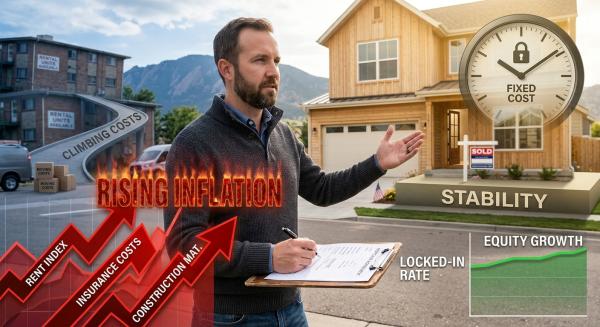
A mortgage locks your largest monthly cost in place while everything around it, rent, insurance replacement costs, construction costs for anything comparable, keeps climbing at that same inflation rate eating your Treasury yield.
A renter’s housing cost is a moving target that only moves one direction. A buyer’s housing cost, outside of taxes and insurance, is fixed the day they close.
Every year that passes without buying is a year of rent paid toward someone else’s appreciation instead of your own.
Third level, and this is the one that gets missed: principal paydown is forced savings you don’t feel.
Every payment moves a slice from interest to equity. Over time that slice grows. It’s not a return you see in a statement, it’s equity that accumulates whether the market moves or not, on top of whatever appreciation happens.
Now flip the inflation math around, because this is where it stops being a headwind and becomes a tailwind.
That same inflation eating your Treasury yield is working in reverse on your mortgage.
A 30 year fixed loan is a fixed dollar obligation. Inflation doesn’t touch the balance you owe, it erodes the value of the dollars you’re paying it back with.
The mortgage payment that feels significant today gets smaller in real terms every year inflation runs, while your income and the home’s value both tend to rise with it. You borrowed today’s dollars and you’re repaying them with tomorrow’s cheaper dollars.
That’s the exact opposite of what happens to a cash holder or a Treasury buyer, where inflation erodes the value of what you’re holding instead of what you owe.
So the same 4.8% inflation rate that strips 80 to 90% off a Treasury yield is quietly paying down your mortgage’s real cost and inflating your equity at the same time.
It’s the same force, working for the ownership side and against the cash side.
For move up buyers, the math looks different, but the conclusion doesn’t.
If you locked in near 3% in 2020 or 2021, trading that for a 7% rate on a new mortgage feels like the challenge that stops the conversation before it starts.
It’s the reason so many move up buyers are sitting still and calling it a decision, when it’s really an avoidance.
Here’s that second level effect. Every year you stay put waiting for rates to come back to 3%, you’re not banking a lower rate.
You’re paying an opportunity cost on two fronts at once. First, the home you’d move into keeps appreciating at that same 6% Colorado average, so the price gap between what you’d sell and what you’d buy tends to widen, not shrink, the longer you wait.
Second, your current home’s equity is sitting idle instead of working as leverage on a larger asset.
Run the actual comparison instead of the emotional one. A rate move from 3% to 7% on a $600,000 loan is roughly $1,400 more a month. That’s real money, no argument.
But that new mortgage is also being eroded by the same 4.8% inflation working in your favor, on a larger loan balance, against a larger asset that’s appreciating in dollar terms because it’s bigger.
The rate is higher. The leverage is also higher. Those two move in opposite directions, and for most move up buyers building equity from a paid down starter home, the leverage effect wins over a five to seven year hold.
Third level: the buyers treating 7% as temporary and refinance-able later are pricing in an option the ones sitting still aren’t. You can renegotiate a rate.
You can’t renegotiate the price gap that widens every year you wait, or get back the appreciation on the bigger asset you didn’t buy.
The 3% rate was never the asset. The house was!!
If the only thing holding you back is the rate on the loan rather than the return on the equity, that’s worth a real conversation, not just a mental math shortcut.
Rates may move up again after tomorrow’s Fed decision. Or they may move down. Or they may not move, who cares. Because the window that matters now, is the one before the next round of savvy buyers figures this out and competition for well priced homes tightens back up. And it will.
There is no doubt in my mind that if you are a buyer now, you are in the driver’s seat; none.
If you or anyone in your circle is weighing buying against sitting in cash, or move up against sitting still, let’s run the actual numbers on a specific price range or property.
I’m sorry, I know there’s a lot in this one, I get geeked up talking about it…….call me and ask what I didn’t make clear.
