
 Facebook
 X
X
 Pinterest
 Copy Link
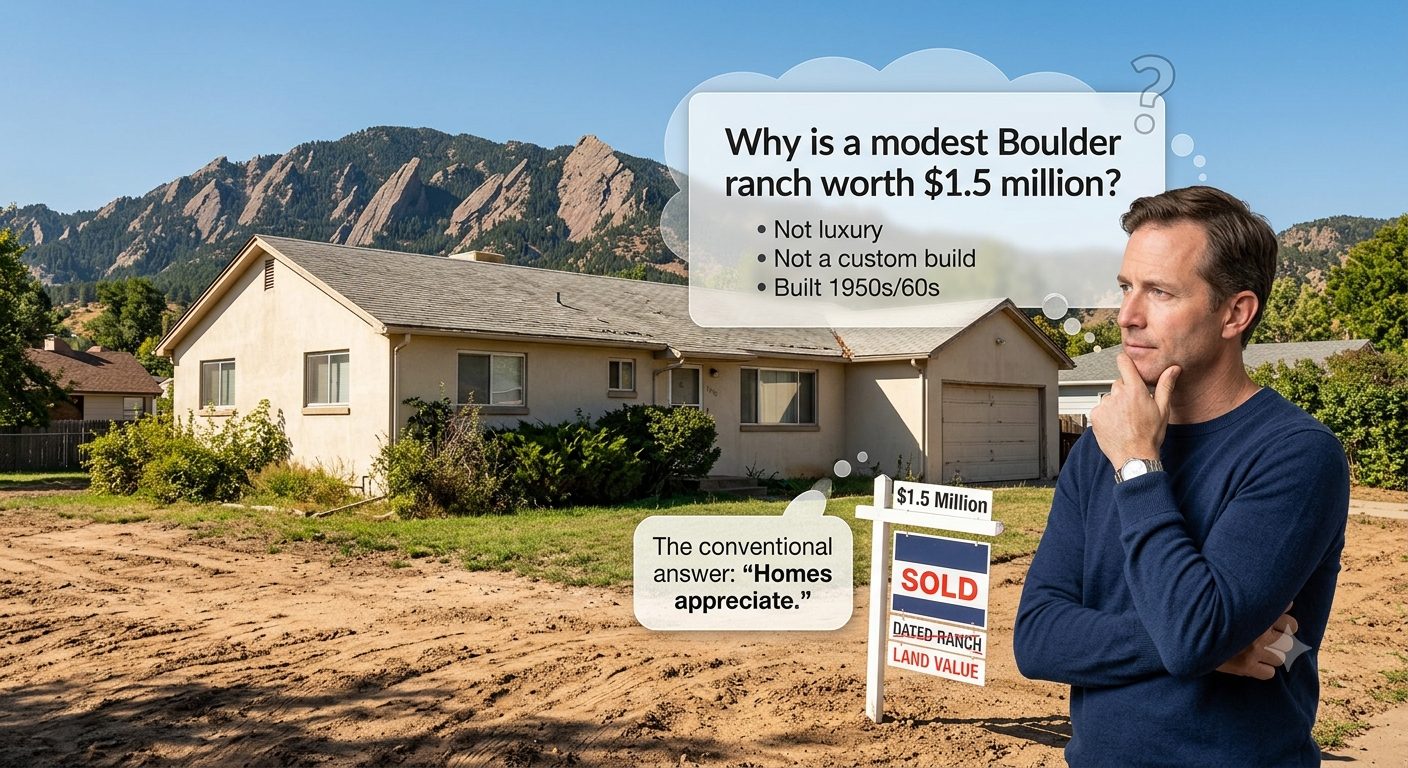
A question has been rattling around in my head this week.
Why is a modest Boulder ranch worth $1.5 million?
Not a luxury home. Not a custom build. Not a 6,000 square foot estate.
A ranch. Built in the 1950s or 1960s.
The conventional answer is simple:
“Homes appreciate.”

But I’m not sure that’s the whole story.
Think about what happens to a house over time.
The roof wears out. The furnace wears out. The windows wear out.
The kitchen becomes dated. The bathrooms become dated.
Every structure eventually needs repair, maintenance, or replacement.
Yet many of Boulder’s oldest homes are worth more today than ever.
What exactly appreciated?
I spent some time looking through recent sales.
A 1956 Martin Acres ranch sold for nearly $1.2 million.
A 1965 Table Mesa ranch sold for more than $1.5 million.
A 1969 South Boulder home sold for nearly $1.6 million.
Then I found a property currently listed in North Boulder for $1.45 million.
The house itself is a modest 1,560-square-foot home built in 1944.
The marketing isn’t really about the house.
It’s about the lot.
Three-quarters of an acre. North Boulder. Mountain views.
Future building potential.
The listing is essentially saying:
Forget the house. Look at the dirt.
And that may be the most honest real estate marketing you’ll see all year.
Because as you move up Boulder’s desirability ladder, a larger and larger percentage of a property’s value comes from the land rather than the structure sitting on it.
Which raises a bigger question.
Why?
Most cities respond to demand by building.
Demand rises. Builders build. Supply increases. Prices moderate.
Boulder works differently.
Open space. Growth boundaries. Geographic constraints. Political choices.
Love those policies or hate them, the result is the same:
In Boulder, when demand rises, supply struggles to keep up.
And when demand grows faster than supply, existing land becomes more valuable.
In many cities, growth creates new neighborhoods.
In Boulder, growth often creates higher land values.
That brings us to the third order effect.
If you’ve owned a Boulder home for twenty or thirty years, there’s a good chance a significant portion of your wealth was created not by remodeling bathrooms or upgrading appliances, but by owning a scarce asset while demand continued to rise around it.
(maybe next week this very phrase will lead us to the ‘how much should I improve my house to sell it?” question. Or maybe even the “should I spend more on the curb appeal and yard than the cosmetics of the home?” question).
Many Boulder homeowners aren’t house rich. They’re land rich.
That distinction matters.
Why?
Because eventually every homeowner faces the same questions:
Do I still need all this house?
Should I downsize?
Should I diversify?
Should I help my children buy a home?
Should I age in place?
Should I turn some of this equity into income?
These answers are different for everyone.
But understanding where the wealth came from is often the first step toward deciding what to do with it.
There is another side to this story.
The same forces that created wealth for a long time owners have made it harder for the next generation to buy into the community.
The people who benefited most from land scarcity are often the same people whose children and grandchildren now face a much higher barrier to entry.
That isn’t a criticism.
It’s simply the economic consequence of a scarce asset becoming more valuable over time.
So the next time someone tells you their house appreciated, I might gently push back.
Maybe the house did.
But here in Boulder, the dirt may have done most of the heavy lifting.
Peace.
PS. If you want to discuss why this matters to you, let me know.
