
 Facebook
 X
X
 Pinterest
 Copy Link
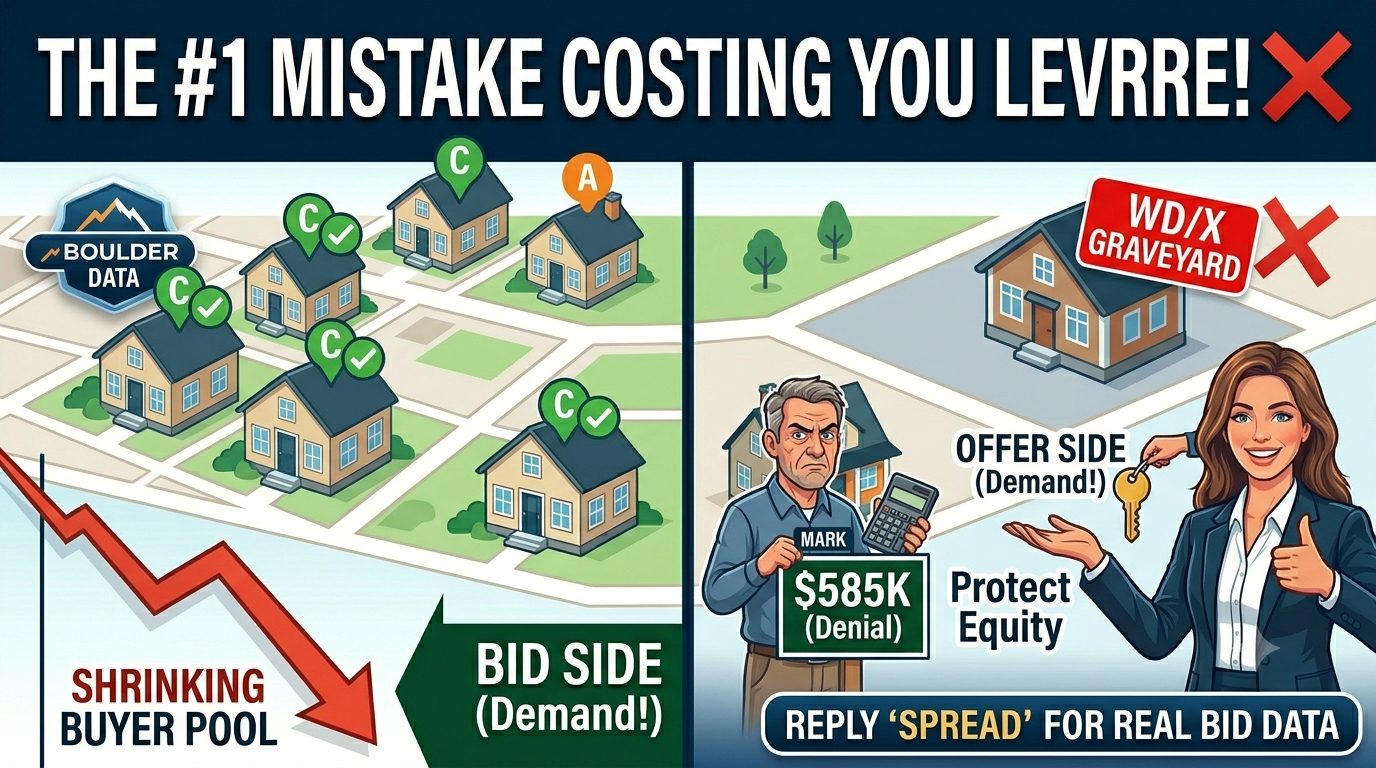
The One Mistake That Costs Sellers the Most Leverage.
For two weeks we’ve unpacked how real-estate pricing actually works; not the generic, algo driven: What’s your home worth? stuff, but the actual way markets price real estate.
The mechanics of where value is really discovered.
Let’s close it out with the story that proves the point.
Mark’s Story. The Cardinal Mistake.
Mark’s in his late fifties. Owns a townhome outright, worth maybe $550-575 K today. Mark has never sold a home in his life; he just bought his second home in Oklahoma.
I met him at an open house a few months back (someone else’s listing, not mine. I do open houses from time to time for other agents to generate buying leads).
Anyway, Mark has the same floor plan townhome as the open house we met at. The open house launched at $625k. No traction. Dropped to $590k. Crickets. It then became one of those withdrawn listings. Meaning the homeowner decided not to sell.
When I saw Mark’s townhome, it had a fresh coat of paint, one updated bath, but same bones. I told him honestly: “Mark, this neighborhood’s softening. You know it, and I know it. And Mark did know it, he had told me “All these townhomes are sitting without offers”.
So continuing our conversation, I said: “If we launch at $575 K, you’ll net about $530-540k. HOA attached housing across Colorado is the softest sector right now. Let’s take advantage of the fact that there is still a bid, and move on. LETS PROTECT YOUR EQUITY.”.
He said, “I need $585 K net. I don’t care what you make.” And I just looked at him. “You’d rather sit on a fully paid-off home, with carrying costs (increasing HOA fees) and a shrinking buyer pool, than take a small down-bid and walk away with half a million dollars clean?”
Mark suggested that he’d be happy to live in Oklahoma six months and carry his vacant townhome for six months a year rather “than sell it too cheap”.
That’s not discipline, that’s denial. So I walked from the listing because the market doesn’t care what you need. With all due respect, I can’t afford to spend time and money on a listing that’s too expensive to sell and the homeowner isn’t motivated to sell it.
The market only cares where buyers are bidding. And every month Mark waits, the bid side probably slides lower.
Next time we talk, it’ll be $525-550 K.
The Lesson:
Every seller thinks is they’re protecting value by staying high or “leaving money on the table” if they drop to the bid side.
But if there’s no table, there’s no money left on it.
Here’s the MLS reality check:
A = Active. You’re in the game and hopefully you’re on the bid side.
C = Closed. You got it done, and got your equity out. Well done, player.
WD / X = Withdrawn / Expired. The graveyard of listings that sat on the offer side too long.
Don’t be an X or a WD. Be a C. Don’t price on or above the offer side; it’s the cardinal mistake.
Don’t ignore the data that is changing every single week. What Mark really lost wasn’t price, it was leverage. When someone wants to buy your home, you have leverage. If it’s priced wrong, no one wants to buy it.
Smart sellers don’t fight the market; they use it. They price into the bid side, where competition and momentum live and let demand pull their price up.
That’s how our first email started: “Don’t sit on the offer side.”
That’s how the second email ended: “Emotion is irrelevant.”
And this one closes the loop: “Markets reward smart action, not attachment.”
If you wish to know where the real bid side is in your neighborhood, and not the wish list prices online from the algos, but where actual money is moving – please reply “Spread.”
I’ll send you a one-page Market Spread Report showing: • Bid range (what buyers are paying) • Offer range (where listings are stuck) • Your optimal entry point to generate interest, showings, and offers.
Don’t be a Mark. Be the C.
