
 Facebook
 X
X
 Pinterest
 Copy Link
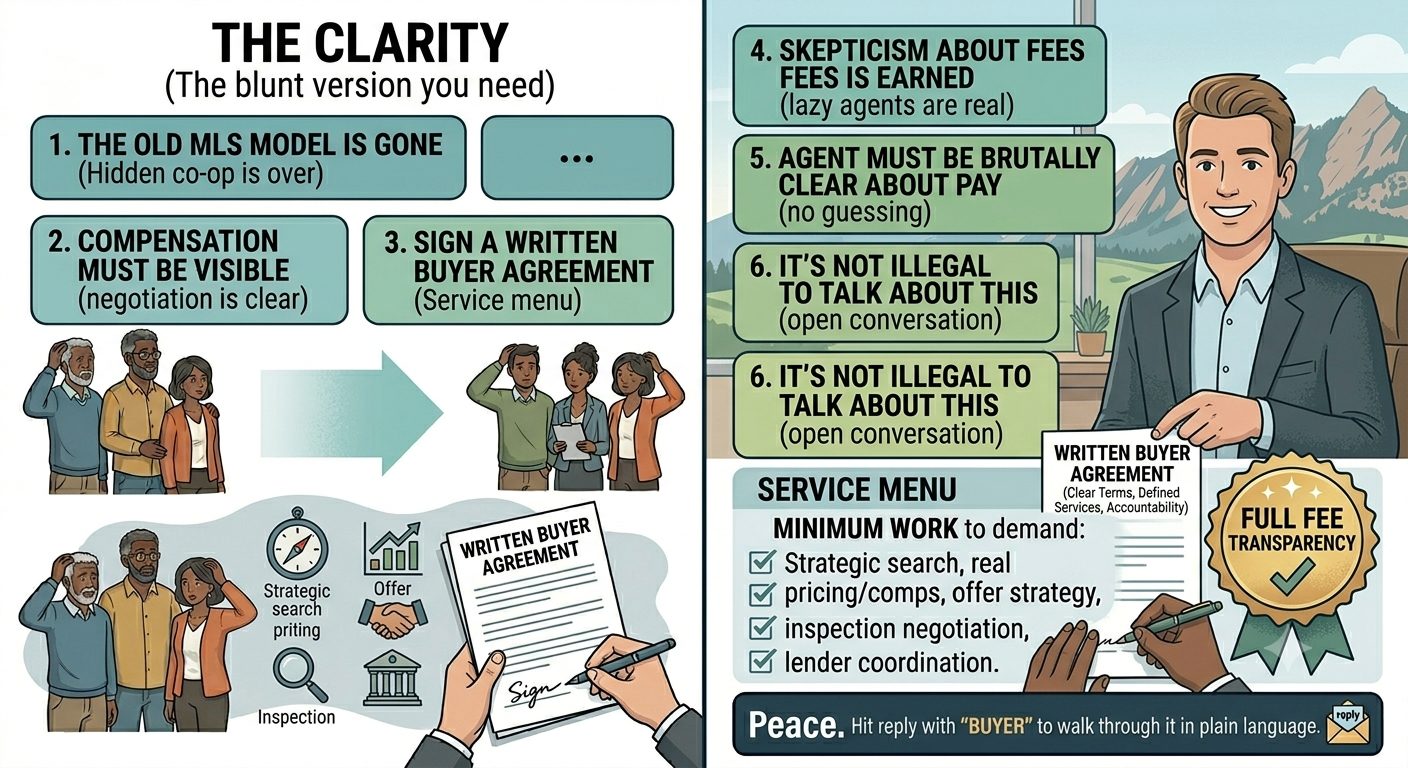
The rules around buyer agents, fees, and the MLS have changed.
A lot of people are not explaining it clearly, so here’s the blunt version of what you actually need to know before you hire anyone or sign anything.

1. The old MLS model is gone.
Sellers used to quietly offer a set fee to the buyer’s agent in the MLS, buyers rarely saw it, and almost nobody explained how it worked. This helped weak agents, because they knew they were getting paid as long as a deal closed, whether they actually did the hard work or not.
2. Compensation has always been negotiable, but now you’re supposed to see it.
In Colorado, the MLS doesn’t publish what the buyer’s agent gets paid anymore, and your agent is supposed to walk you through how they’re paid before you see homes. It has always been negotiable; if you didn’t know that, ask yourself why your last agent never told you, and why you’re thinking about hiring them again.
3. You now sign a written buyer agreement before touring.
That agreement should spell out what your agent will do, how they get paid, and what happens if the seller doesn’t cover their fee. It should read like a clear service menu; if you’re committing to pay someone, you should know exactly what you’re buying. If your agent can’t explain it in plain English, that’s a problem.
4. Lazy buyer agents were a feature of the old system, not a bug.
When the co-op fee was guaranteed in the MLS, it was easy to be a “door opener” who did the bare minimum for the same paycheck as someone who went to war for their clients. Yes, some agents are terrible. Your skepticism about fees is earned.
5. Your buyer’s agent should be brutally clear about how they get paid.
They should tell you, up front, what they charge, what they expect the seller to contribute, what happens if there’s a gap, and how that gets handled in price, credits, or your cash. If you feel like you’re guessing, your agent isn’t doing their job.
6. It’s not illegal to talk about this stuff.
There are rules around how agents talk about compensation with each other, but it is absolutely not illegal to tell youhow this all works. It should be more of a problem when people avoid the conversation than when they have it.
7. There’s a minimum level of work you should demand from any buyer’s agent.
Bare minimum: strategic search, real pricing and comps on every serious property, offer strategy for terms, timing, and structure, inspection and repair negotiation, and coordination with lenders and other pros. If you’re not getting that, you’re overpaying at any fee, period.
8. It costs real money to run a real business.
That “X%” or whatever you see on a settlement statement is not what lands in an agent’s pocket. There are substantial hard costs, including marketing, data, staff, platforms, insurance, and compliance, before you even get to time, experience, and judgment. A serious operation costs money to keep standing.
9. Past fees don’t matter; current value does.
I don’t care what you paid your last agent or what your dad paid 20 years ago. I care what you want now: speed, discount, protection, leverage, or some mix of those. The fee has to match the outcome you’re targeting. If your entire framework is “my brother in law will do it for X,” you should go hire him. I can’t strip out the work that keeps you from getting hurt just to match someone else’s mystery “it.”
10. You should be able to see exactly what you’re getting for whatever you pay.
If you’re paying a premium, you should see clearly defined services, standards, and accountability, not vague promises. Don’t sign a buyer agreement that doesn’t spell out what you get in real world terms. You should be able to ask for introductions to past clients and see what that looked like in an actual deal. I’ll happily intro you to my past clients.
If you’re considering a purchase, let’s have a conversation about how this works before you sign anything. Hit reply with “BUYER” and we’ll walk through it in plain language.
