
 Facebook
 X
X
 Pinterest
 Copy Link
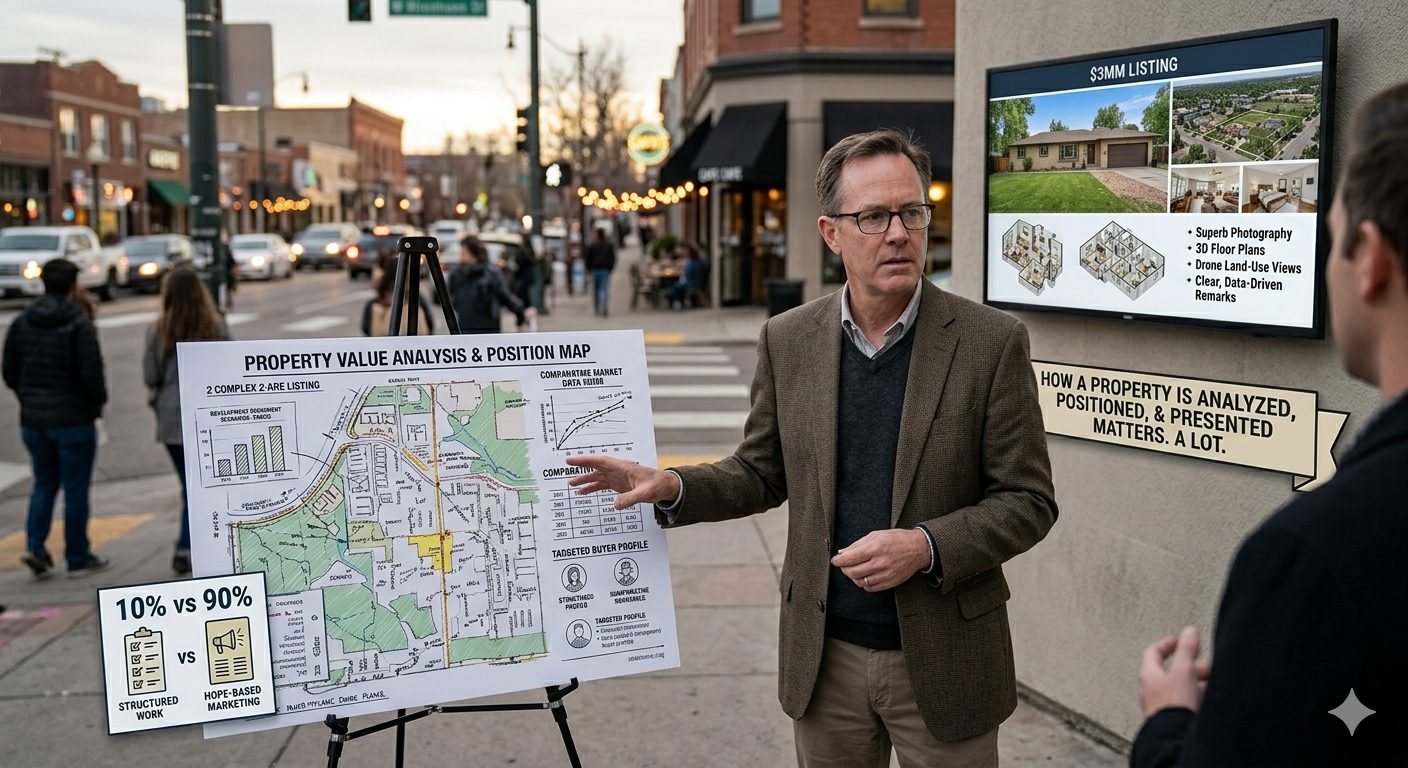
When I say 10% of agents do 90% of the work, I’m not trying to be the guy on the corner complaining about the business. I’m trying to point out something that has a real impact on value: how a property is analyzed, positioned, and presented to the market matters. A lot.

I was looking at a new $3mm listing in South Denver that’s being marketed as an investor / builder opportunity on roughly 2 acres with an existing home and ADU. On paper, that sounds interesting. But the way it’s being presented is a great example of the gap between putting a listing online and actually packaging an opportunity.
Publicly, you get six basic iPhone photos for a $3M asset. They don’t really show the land, the egress points, or how the structures sit on the parcel. There’s no real sense of approach, privacy, or neighborhood context. In a situation where layout, access, and land use are everything, those photos actually hurt more than they help because they create questions instead of answering them.
Then you read the remarks, which lean heavily on broad phrases like “exceptional opportunity,” “endless possibilities,” “great potential,” and “investor and builder opportunity.” It sounds exciting, but it’s all vibes, no substance. It doesn’t tell a serious buyer what the likely best play is, what the challenges are, how it compares to other options, or why this specific property deserves attention over competing inventory.
That’s where my team and I take a different approach, and it applies to every listing we handle – whether it’s a $350,000 townhome, a family home, or a more complex project with a seven figure tag. We start with the same framework every time:
- The goal – What are we actually trying to accomplish: top dollar, better terms, a faster exit, a smoother move, or a more strategic buyer match.
- The challenge – What could get in the way: condition, layout, location, buyer perception, timing, financing, or property-specific complexity.
- The solution – What is the smartest strategy given those realities: improve it, reposition it, price it differently, target a different buyer, or package it around a specific use case.
- The presentation of the solution – This is the most important part, and sadly the part most people skip. Real packaging means visuals, copy, context, data, and supporting information that make the value clear to the right buyer. Six careless photos and vague language are the opposite of that.
- The way to get there – The roadmap, timing, and people involved to turn the idea into an actual result.
For me, most of this comes back to three core levers: condition, price, and timing. Condition is how the property stands up against the alternatives a buyer can choose from. Price is how the ask fits the story being told and the reality of the market. Timing is how the listing is positioned against everything else available right now. And presentation is what ties those three together so the property doesn’t just exist online – it actually makes sense in the mind of the buyer.
Our job is not to “hope the right buyer shows up.” Our job is to find the right buyer. To do that, you need real analysis, and you need real packaging. You need to understand the property clearly enough to tell the story well, answer the obvious questions up front, and present it in a way that reduces friction instead of creating it.
A big part of that is having the relationships to get the information that matters – whether that’s market context, planning insight, prep help, vendor coordination, or outside expertise when needed. That only matters because it helps build a clearer strategy and a better presentation from the start.
So this isn’t really about taking shots at one listing. It’s a reminder that good representation is not automatic. It takes thought, work, and standards. That’s the standard my team and I bring to every property we represent.
