
 Facebook
 X
X
 Pinterest
 Copy Link
——————————————————–
Edit: To you dear reader, I start with apologizing for mailing this one in.
Radon? Really, Mike? That’s what you have? I almost fell asleep writing it; please don’t feel bad giving this one a pass.
They can’t all be triples in the gap.
Sorry, it’s been a busy week and I’ll get back on track on the next one.
Godspeed.
g
———————————————————-
What radon is, why it matters in Colorado, how testing works, and what happens if a result is high.

You may have heard the word radon during a home inspection, a real estate transaction, or a conversation with a neighbor, but many people are not exactly sure what it is or what they are supposed to do about it.
Here is the straightforward version.
What is radon?
Radon is a naturally occurring radioactive gas created as uranium in soil and rock breaks down. It is not something caused by a dirty house, an old house, or poor maintenance. It is part of the natural environment.
The issue is that radon can move up from the ground and enter a home through small openings in a slab, basement, crawl space, foundation walls, utility penetrations, sump areas, or floor cracks.
You cannot see it. You cannot smell it. You cannot taste it.
That means testing is the only way to know what level is inside a particular home.
Why does it matter in Colorado?
Colorado is a high radon state. The Colorado Department of Public Health and Environment says that all Colorado counties are in EPA Zone 1, and about half of Colorado homes have radon levels above the EPA’s recommended action level.
.
That does not mean every home has a problem.
Homes next door to each other can test very differently.
A new home can have radon.
An older home can have radon.
A home with a basement, crawl space, or slab foundation can have radon.
The only meaningful answer for your home is a test.
What does the test tell you?
Radon is measured in picocuries per liter, written as pCi/L.
The EPA recommends taking action when a home has a confirmed radon level of 4.0 pCi/L or higher.
There is no completely risk free level of radon exposure, and levels below 4.0 pCi/L can sometimes be reduced as well.
For a homeowner, a short term test provides a useful snapshot. For a buyer under contract, a professionally managed test is commonly completed during the inspection period and typically needs at least 48 hours of closed house conditions.
For a home you already own, longer term or continuous monitoring can provide a broader picture because radon levels can change with weather, season, heating and cooling patterns, and how the house is used.
What if the number is high?
This is the key point: an elevated radon result is usually a fixable issue, not automatically a reason to walk away from a home.
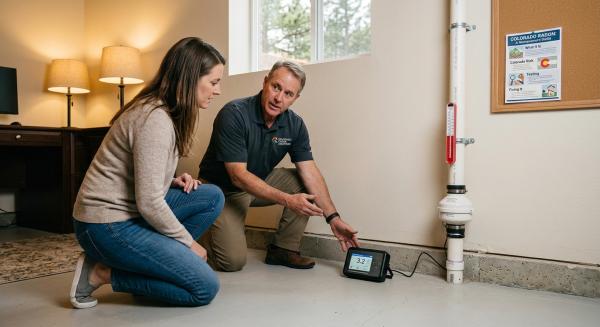
A qualified radon mitigation professional can install a system designed to pull soil gas from beneath the house and vent it safely above the roofline.
The most common system uses a pipe and a small fan. After installation, follow up testing should confirm that the system is working and that radon levels have been reduced.
Based on the homes I have recently been selling, a typical radon mitigation system is currently running about $1,500 to $2,500, depending on the home, foundation configuration, and system design. Larger homes, multiple slab areas, finished basements, or more complex installations can cost more.
For sellers, addressing radon before or during a sale can turn an unknown into a documented solution.
For buyers, it is usually a repair, negotiation, or credit discussion, similar to other inspection findings, not necessarily a deal breaker.
When should you test?
Consider radon testing if:
You have never tested your current home.
You are buying a home and are in the inspection or due diligence period.
You are preparing to list and want to avoid a last minute surprise.
You are finishing a basement, remodeling, or changing how you use the lowest level of the home.
You already have a mitigation system and want to verify it is operating effectively.
Whether you are buying, selling, or simply want more clarity about the home you already own, we are happy to help you understand the process and connect you with reliable local testing and mitigation resources.
Reply RADON if you would like that resource list.
