
 Facebook
 X
X
 Pinterest
 Copy Link
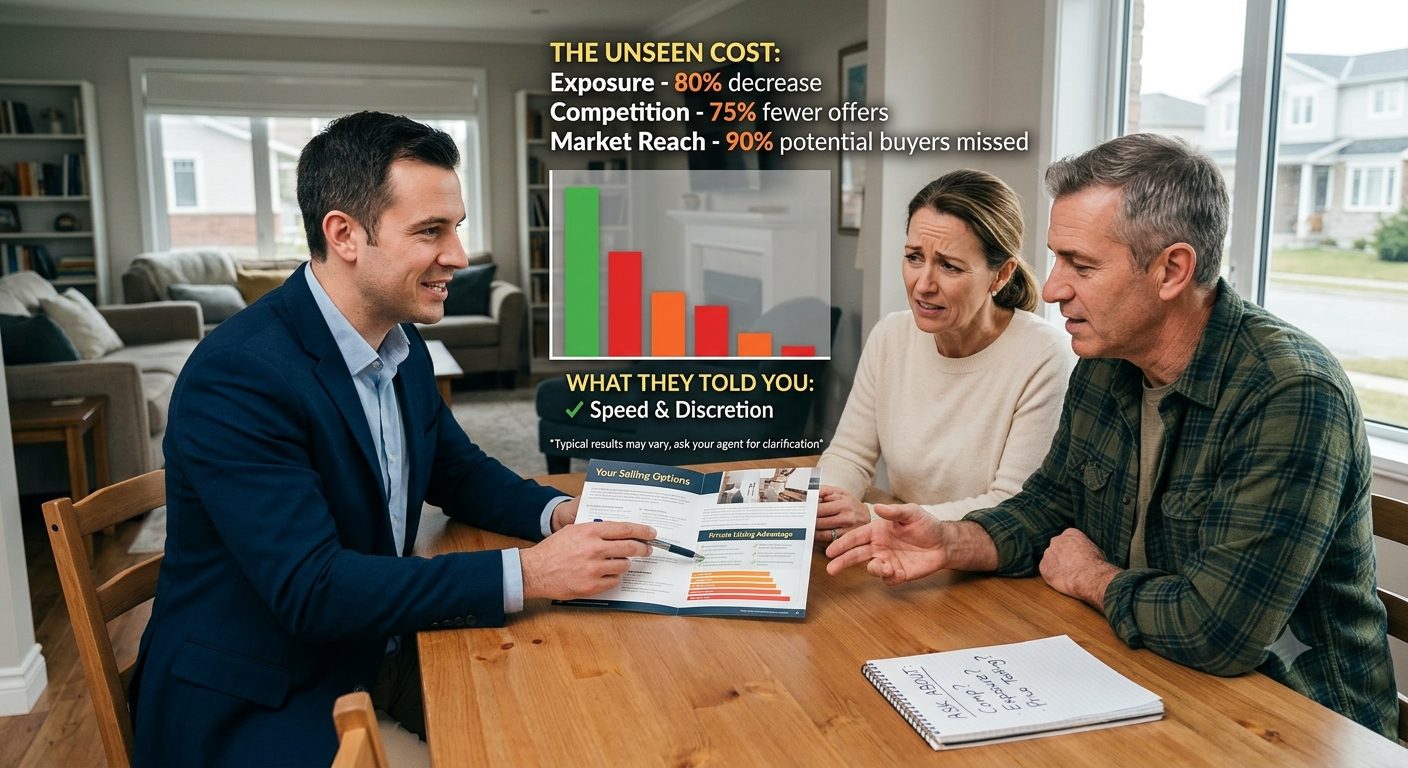
I’ve written about this recently because I think private listings are worth talking about honestly.
My position is simple: private listings are not automatically bad.
In the right situation, they can be the right move for the right seller.
They can protect privacy, reduce unnecessary exposure, create a more controlled launch, and give a seller time to test price and gauge demand before going fully public.

That said, a private listing only works if the agent understands what it is, can explain it clearly, and knows how to use it for the seller’s benefit; not the brokerage’s.
That’s the part a lot of people are missing.
A good agent should be able to answer three questions without hiding behind jargon:
Does this strategy make sense for my client’s property?
What is my seller giving up by not going public right away?
How is this helping my seller reach their goals?
If your agent cannot answer those questions clearly, then they don’t really understand the strategy.
And if they cannot explain the tradeoffs clearly, do you really want to hire them to move maybe the biggest asset you have?
Here’s the real issue: private listings can absolutely be used well.
They can also be used badly.
The difference is whether the seller is making an informed decision, or whether the seller is being nudged into a system that primarily benefits the brokerage, the agent, or the in house deal flow.
That’s why I don’t view this as a black and white issue.
For some sellers, privacy matters. For some properties, timing matters.
For some situations, it makes sense to test the market before going fully public.
And in those cases, private listings can be a real advantage.
An example: Maybe your home is not cookie cutter in a development. Maybe it has acreage and theirs no recent comps to price it.
Maybe dollars per sq foot gets you somewhere, but it’s challenging to tighten up to a legit bid/offer spread.
In this case, maybe explaining:
“I think a fair offer is x, but it could be potentially 10-12% above that”.
If this happened to me, I’d handle this conversation with you and tell you something like this:
“Why don’t we reach for the moon here and offer at the high price? Taking days on market into account, let’s reassess at 10, 20, or 30 days.
“If we don’t have any offers or enough showings or the right feedback, we’ll lower the price then and go wide on the MLS at that point with no days on market burned” (which hurt the perception of the listing in the street).
“Now your downside Mr. Seller is that someone comes in and pays you that initial price and the property hasn’t been fully shown in the street; perhaps it would have gone even higher”.
But in the event Mr. Seller doesn’t get the 10-12% premium, he’s effectively gotten 10-30 days of ‘free’ marketing and feedback without aging his listing.
And not aging your listing is valuable.
But the strategy only works when it is used intentionally.
The mistake is when “private” becomes the default, or when the seller is told what sounds good without being told what it costs them in exposure, competition, and market reach. That’s where the conversation gets dangerous.
So, my position is not anti private listing.
My position is pro choice, pro strategy, and pro seller.
If private is the best tool, use it.
If public exposure is the better move, do that. But the agent has to understand the tool, explain the tool, and use the tool for the client’s advantage; not the firm’s.
That’s the difference between fiduciary responsibility and salesmanship.
The best agents don’t just know how to list a home.
They know when privacy is smart, when exposure is smarter, and how to tell the difference without serving their own interests first.
Peace.
