
 Facebook
 X
X
 Pinterest
 Copy Link
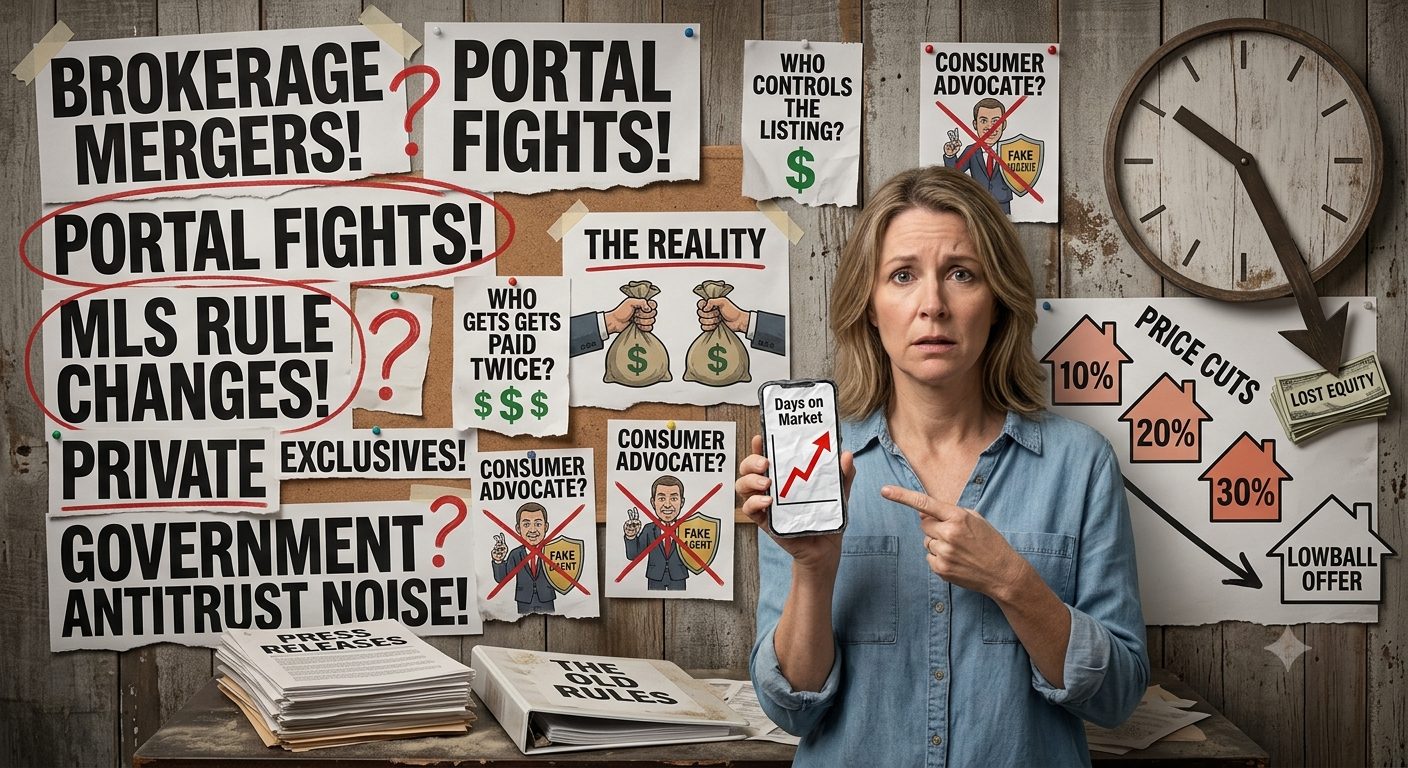
If you’ve glanced at real estate headlines lately, you might have seen the drama: big brokerage mergers, “private exclusive” networks, portal fights, MLS rule changes, and government antitrust noise.
Everyone is suddenly a consumer advocate; at least that’s how the press releases read.
Here is the uncomfortable truth: a lot of these battles seem to be about who controls listings and who gets paid twice, not about getting you the best result when you sell.
Control the pipeline, control the leverage. But that’s not the full story.
In this environment, “days on market” is not just a number; it is a signal. The longer a home sits, the more buyers assume it is overpriced or that something is wrong, and the more they feel entitled to lowball or wait you out. Listings that linger usually need deeper price cuts and end up selling for less than homes that were priced correctly and moved quickly.
Time on market is not neutral; it is financial.

“Yeah, Gebby, get to the point, we know all this.” Fair.
One argument for private or off market phases is that they can give you room to test pricing and gather feedback without racking up public days on market on the MLS.
If we overshoot the price and have to adjust, doing that behind the scenes can keep your public DOM clean so you don’t look stale or desperate when you finally hit the open market.
For certain high privacy, high profile, or timing sensitive sellers, that kind of controlled rollout can be useful if you understand exactly what is happening and why.
But that same private phase can quietly become a way for a brokerage to keep the listing inside its own ecosystem longer, chase both sides of the deal, and limit who really sees your home. Some strategies are designed first to grow corporate leverage with more inventory controlled in house and more chances at both sides of the commission and only second to serve the seller.
The difference between a smart tool and a bad trade off is whether the strategy is being run for your benefit or for the firm’s balance sheet, and whether you’re fully informed about the impact on exposure and leverage.
For many everyday sellers, broad, transparent exposure and immediate MLS plus full portal distribution is still the cleanest path to real price discovery and negotiating leverage.
But for others, especially high privacy, high profile, or high priced situations, a tightly controlled rollout with some private testing can make sense, because it lets you adjust without burning public DOM or broadcasting your plans before you’re ready.
The trick is knowing which camp you are in and making that decision with all the incentives and trade offs on the table.
In short, I get to call bullshit when I see it.
Full disclosure: I work inside the same ecosystem that rewards double sided deals and private information.
I know exactly how those incentives work and that’s why I talk about them openly with clients instead of pretending it is all “consumer protection.”
Limited or private exposure is not something to be dismissed outright. It is a legitimate tool: privacy, timing, testing, off market conversations, and when it is used deliberately, with your eyes wide open, it can be helpful.
The problem is when a tool quietly turns into a default pipeline that benefits the brokerage more than the seller.
I have watched this movie before. I spent 25 years on Wall Street, and I lost that career when technology and new models made a lot of what I did for clients obsolete. I remember one day all us old guys looking around the room saying, “Hey, is it getting cold in here” and finally realizing we were living through our own ice age.
The firms that were not paying attention got hurt, and so did a lot of professionals who thought the old rules would protect them.
Real estate is now going through its own version of that transition.

My goal here is simple: I am not here to defend the old guard or cheerlead the new one; I’m here to make sure you do not get blindsided by changes you never voted on.
Regulators, portals, and big brokerages will all keep saying they are “protecting consumers.”
My focus is narrower and more practical: protecting you, your equity, your privacy, and your options inside whatever system they build next. For me, protecting consumers means explaining exactly who gets hosed in each scenario, without dropping too many F bombs.
My philosophy is straightforward:
We start with your goals, your property, and your tolerance for visibility.
We look at how DOM, pricing, and exposure actually play out in the current market, not in a brochure or a talking point laden Facebook post.
We treat limited exposure as a tool, not a religion, and only use it when it clearly serves you.
It might; my job is to explain the specific potential benefit to you.
If a strategy does not obviously benefit you, we don’t do it.
If you are thinking about selling in the next 12 to 18 months and want a straight, non corporate answer on whether a “private” or phased approach would help or hurt you, I am happy to walk through it with your specific situation.
PS. A disclaimer.
I work at Coldwell Banker Realty, and that shop was just bought as part of Anywhere brands by Compass. Compass is engaging all comers in this bruhaha. For those of you who know me, I do not shill for anyone. I have an opinion, and it is still being informed. Happy to debate it.
That said, I look forward to being part of Compass and their tech stack; it will benefit you, gentle reader.
