
 Facebook
 X
 Pinterest
 Copy Link
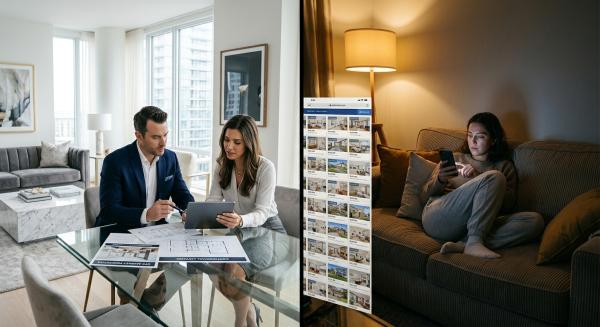
A lot of buyers I talk to have the same search routine. Saved filters on Zillow, notifications on, and a quiet belief that when the right house shows up, they’ll see it first.
They won’t.

Right now I’m working on bringing to market a unique home with all the bells and whistles in an in demand area. Special homes like that rarely wait for an algorithm to find a buyer. They get talked about between agents who are actively shopping for specific buyers.
If you are relying on Zillow, you’re not getting the first look.
This week a buyer emailed me who already has an agent. He’s considering a switch. His words: his agent isn’t doing anything with marketing and promotion.
I hear some version of that more often than you’d think, and it isn’t about effort. It’s about a model.
Setting up a portal search and waiting is what a lot of the industry now calls representation.
Here’s why that matters more than it seems.
Its not 2022, and rates aren’t forcing people to buy real estate. Rates are over 7, and for you to buy real estate now certain things have to be true.
Your return for not buying real estate has to be lower than the sum of your appreciation rate (less expenses) and the utility for the new property.
The utility gained, for whatever period you expect to live there, has to be worth more than the aggravation of buying and the marginal transaction costs.
If these are true, it stands to reason you want to see the better homes before the next guy.
When the best homes trade through agent networks before they go public, what’s left on the portal isn’t a random sample.
It’s disproportionately the homes nobody grabbed early. Buyers scrolling Zillow aren’t seeing the market. They’re seeing the leftovers, and then negotiating as if those leftovers tell them what everything is worth.
It goes further. The comps, the days on market, the list to sale ratios everyone quotes are all built from homes that closed publicly.
When more of the good inventory moves quietly, the public data starts lagging the real market. A buyer reading Zillow is reading last month. A seller pricing off portal comps is pricing off the homes that didn’t get picked first.
Now flip it to the seller side.
Buyers are at a premium. With rates well over 7% thinning the pool, every serious buyer matters, and most of them are already working with an agent who knows what they want.
So the question is simple:
-do you want your home in front of the agents who are talking to those buyers today, or do you want it added to the pile of inventory everyone is scrolling past?
Broadcast marketing has a hidden cost. When a home goes live to everyone at once, the first feedback often comes from the least motivated buyers: the browsers, the low ballers, the ones who will “wait and see.”
If nothing happens in two weeks, the market starts pricing your home off that silence. Days on market become the story, and the story becomes a price cut.
This is where the tools have changed. Through CIH I can see buyer demand data, including which agents have buyers actively searching for a home like yours.
That flips the process. Instead of listing and hoping, I start with the people most likely to write an offer and build out from there.
If the right buyer is already out there, we find them first. If not, you still get full exposure, just with real demand data behind the price instead of guesswork.
That’s also why the agent you choose compounds. Agents with deeper networks and better data get more inbound buyers, which gives them more to offer the next seller, which brings them more listings.
The delta between an agent working the market and an agent waiting on it keeps widening. Is your agent working the market in 2026, or are they waiting for the phone to ring as in 2022?
If you’re thinking about selling, ask any agent you interview: who are you calling before the sign goes up, and can you show me the buyer demand for my home right now?
And yes, you should be asking me those questions.
What I’d do:
Buyers: Ask your agent what they’re doing beyond the MLS feed. If the answer is “setting up a search,” that’s a challenge.
And it’s kind of like a combover or velcro sneakers. It might work, but the results are suspect.
Sellers: Ask to see real buyer demand for your home before you list, not after. Price off buyers, not off stale comps.
Owners: Keep your filters. Just don’t mistake them for a strategy, and don’t mistake portal data for what your home is actually worth.
Because the delta between portal algo pricing and what buyers are currently paying keeps getting wider.
Don’t make important decisions on bad data.
Peace
