
 Facebook
 X
 Pinterest
 Copy Link
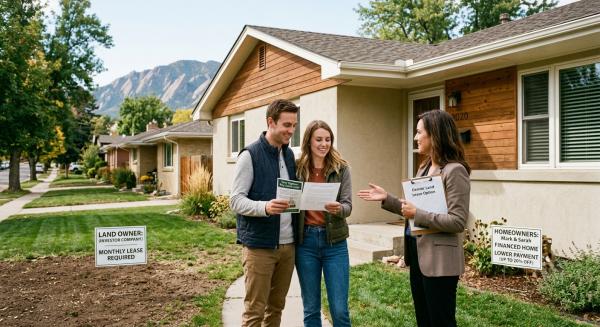
An email hit my inbox this week telling me a home in Denver now qualifies for a program that could cut a buyer’s initial monthly payment by an estimated $1,195.
https://www.estately.com/
That got my attention. It should get yours too, just for different reasons.
How it works
· A company buys the land under the house
· You buy only the house
· You lease the land back from them every month
· Because you finance less, your initial payment can drop up to 20%
· You can buy the land later, refinance, or sell whenever you want

First level read: lower payment, more buyers qualify. Sounds great.
Second level read: On the Front Range, the house isn’t what appreciates. The land is. A 1950s ranch in Highlands isn’t worth what it’s worth because of the drywall and the roof. It’s the dirt. Structures depreciate. Land appreciates.
So this structure splits the asset and hands you the part that depreciates, while an investor holds the part that grows.
Third level read: Why does this exist at all? Because capital markets have decided the affordability gap is a business. Prices aren’t falling. Rates aren’t falling. So the industry keeps inventing new ways to slice the asset until the monthly payment pencils.
Dear reader, this reminds me of my Wall Street years, watching Kidder Peabody slice and dice home mortgage cash flows.
One investor buys the AAA piece: Orange County borrowers who will essentially never default, at a price that yields 6%. Another investor buys the BBB piece: more inland, working folks, with a meaningfully higher default rate, at a price that yields 8%.
Is that extra 200 basis points enough to cover the potential losses? I don’t know. But when Wall Street decides it can shave a few basis points off a pool of anything, history has taught us it helps some and hurts others.
So who holds which slice here, and where does the risk actually live?
The homeowner’s risk is evident and out front. You hold the structure, which depreciates. It’s financed with a mortgage, so it’s leveraged. And you owe a lease payment on the dirt that likely escalates. You can see every bit of that on day one.
The investor’s risk is quieter. They hold the land, collect ground rent, and in most ground lease structures their claim sits ahead of everyone else’s. Looks like the AAA piece. But ask where their risk is:
· Land is the volatile part. When prices fell in 2008, land values dropped harder and faster than the structures sitting on them. The appreciating slice is also the slice that falls first.
· Rate risk. Ground rent is a long, slow income stream. If rates rise and the escalator lags, that stream is worth less than what they paid for it.
· Default risk. If a homeowner stops paying, the investor owns dirt under a house they don’t own, with a lender and a homeowner in the way.
· Liquidity risk. Selling thousands of scattered residential lots isn’t like selling a bond.
· The option they sold. If the buyback is capped and Front Range land keeps running, the homeowner collects the upside and the investor collects rent. More on that below.
And one more level almost nobody talks about: every tool that lowers the monthly payment eventually gets baked into the price. Payment relief today can become price support tomorrow. The affordability challenge doesn’t get solved. It gets refinanced.
Where I land…..(Bahahaha, did you see that?)
I actually like this. For the right buyer.
Think of it this way: you’re renting the land with an option to buy it later.
If that sounds exotic, it isn’t. It’s exactly how the biggest homebuilders in America operate now.
A decade and a half ago, builders bought land outright and sat on it. That’s how many of them nearly went under in 2008: holding acres of dirt nobody wanted, financed with debt. The lesson stuck. Today the large national builders mostly control land through options. A land banker owns the lots, the builder pays an option premium for the right to buy them on a schedule, and if the market turns, the builder walks away and loses the option premium instead of the company.
The builder has his downside capped. Upside kept.
And right now those same builders are puking incentives at buyers, rate buydowns, closing costs, upgrades, because they’d rather move homes than hold them. That tells you where the smartest money in housing thinks the risk sits.
So the land lease buyer is borrowing the builder playbook. Your monthly ground rent is your option premium. I’m honestly still working out how I’d want that premium priced at inception. But I know exactly what I’d want on the other side of it:
A hard cap on the buyback price. The amount you’ll pay to own the land outright someday should be known the day you sign. That’s your downside. A builder would never sign an option without a fixed strike price. Neither should you.
If the buyback floats at future market value, you’re mostly paying rent for the privilege of qualifying today. If it’s capped, you own a real option on Front Range dirt, and the investor is the one who sold it to you.
And the county hands you the scoreboard for free. Your assessor’s value notice splits every property into land value and improvement value. Colorado reappraises every two years, so pull the split before you sign and watch the land number every cycle. Assessor values lag the market, so treat them as a trend line, not a price. But the trend tells you when that capped buyback is starting to look cheap.
Who this is for
· Younger, scrappier buyers who can ride the appreciation curve up
· Buyers willing to add value through improvements, and build equity in the part they own
· Buyers with a plan to lock in the land within a few years, not someday
Who this is not for
· The older, risk averse buyer who needs clarity today
· Anyone who wants to know exactly what they’ll owe in year ten
· Anyone who plans to sign and stop paying attention
Because that’s the whole game. A builder can walk away from an option. You live on top of yours.
If you or someone you know is looking at a land lease offer, send it to me before signing.
Peace.
