
 Facebook
 X
X
 Pinterest
 Copy Link
Last week I sent a note about the Compass/Anywhere merger drama, private listings, and who really benefits when inventory gets kept in‑house.
If you missed it, here’s the link
That was the big picture. This is the zoom in: how days on market and condition actually behave in our Boulder and Front Range market right now, and what that means for you.

Right now, the local data says we’re in a kind of “equilibrium” market. (Read Here)
Inventory’s high, price appreciation’s flat, and buyers have real negotiating power.
Under the surface, though, there’s a sharper split: truly move in ready homes and “needs work” homes are living in two very different universes.
Walk into a showing and you see it immediately. Buyers run their fingers along windowsills, check the age of the water heater, and ask about the roof before they even comment on the kitchen. Condition’s quietly become the currency that matters most. Turnkey homes are commanding a premium.
Deferred maintenance is getting punished in price and time.
In that environment, days on market isn’t just a number; it’s a financial signal.
The longer you sit, the more the market assumes something’s wrong and starts to discount you.
You get hit three ways at once:
-the price you achieve,
-the concessions you give,
-and the dollars you end up spending on improvements anyway after the fact.
Buyers almost always overstate repair costs. In real life, they routinely pad those numbers by 50-150 percent in their heads.
Worse, once they see visible issues, they start asking, “If the sellers didn’t fix this and I can see it, what did they neglect that I can’t see.”
That doubt shows up in the offer, in the inspection negotiation, and in how hard they’re willing to push you because your DOM already says you’re on your back foot.
Now drop the merger and the private listing tools on top of that.
When Compass first started beating the drum about private exclusives and in house phases, my bullshit meter was pegged. From the outside it looked like “trap the inventory and double‑end more trades.”
I’ve spent most of my career rolling my eyes at anything that smells like that. I don’t do corporate speak, partly because I speak it and I know exactly how it’s used to hide incentives.
At heart I’m a “go wide, clean DOM, let the market decide” guy.
But I’ve evolved.
In this specific Boulder / Front Range market, with condition and DOM doing this much heavy lifting, I can see where a short, intentional private phase becomes a rational tool for the right seller.
If we know there are repairs or upgrades that will matter, and I can help you finance with nothing out of pocket till closing, it can make sense to handle that before we light up the MLS.
If we know the pricing’s uncertain, it can make sense to quietly test and get feedback from smart and trusted agents before we rack up public days on market. That’s not a scam; that’s sequencing.
And here’s the part almost no one says out loud.
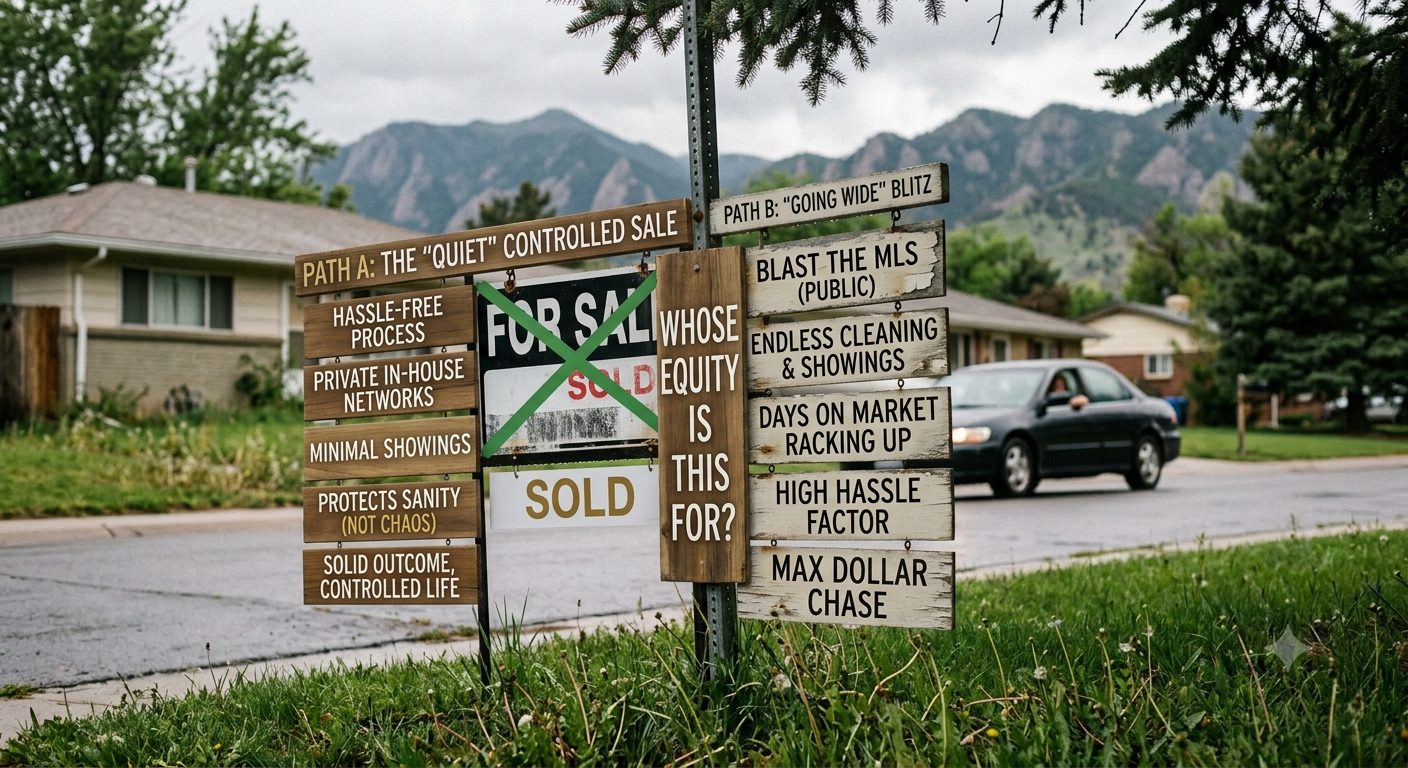
For some people, it might actually be worth ten thousand, twenty thousand, fifty thousand dollars or more to not go wide. If the extra money you might squeeze out by blasting the MLS isn’t worth months of showings, cleaning the house every day, shuffling kids and dogs out for thirty to sixty minutes at a time, and living inside that nonsense, then we should say that out loud too.
In that scenario, a controlled in house or private process that gets you a clean, solid outcome with less chaos might be the smarter play. Not just for your spreadsheet, but for your life.
The fine line is who the sequencing’s for.
If a “private phase” is really a way for a firm to trap inventory, chase both sides of the deal, and quietly limit who sees your house, I’m out.
If a private phase is a way to protect your DOM signal, reduce your hassle, and improve your true net after repairs and concessions, I’m in.
That’s where the next uncomfortable question comes in.
It’s not just about whether these tools exist. It’s about whether your agent’s strong enough to explain the nuance and the money.
Is your agent savvy enough, and independent enough to even recognize when they’re being used as part of a corporate pipeline?
Do they actually understand how private phases, referral fees, double ended deals, and MLS visibility move dollars between different balance sheets?
Can they look you in the eye and explain the difference between “we’re protecting your DOM and your privacy” and “we’re quietly limiting competition for your listing?”
If they can’t walk you through that distinction in plain English, with no buzzwords, you’re betting your equity on someone who doesn’t fully understand the game they’re playing.
For the record, I don’t think NAR or the MLS structures are neutral referees either.
They protect their dues, their data, and their rules. FULL STOP.
My job’s narrower and far less polite: protect you, your equity, your privacy, and your options inside whatever system they build next.
I refuse to be beholden to any of these players when their incentives diverge from yours, not mine.
Here’s where I land.
We start with your goals, your property, and your tolerance for visibility and hassle.
We look at how DOM, pricing, condition, and exposure are actually behaving in today’s Boulder and Front Range market, not in a brochure and not in a talking point‑filled social media post.
We treat limited exposure as a tool, not a belief system, and we only use it when it clearly serves you.
If a private or phased strategy doesn’t obviously benefit you, we don’t do it.
I’m very good at the classic “go wide” play. Prep hard, build demand, stack a massive first weekend open house, and sell in the first couple weeks when the property and the plan support that outcome.
That’s still often the right answer.
But maybe that’s not what you want or need.
Maybe protecting your time, your privacy, your family’s sanity, and your public DOM is more important than chasing every last dollar. Maybe a quieter, smarter rollout, with less chaos and more control, is the better fit for where you are in life right now.
Let’s talk.
If you’re thinking about selling in the next twelve to eighteen months and want a straight, non corporate answer on whether a private or phased approach would help you or hurt you, I’m happy to walk through it with your specific situation.
Peace
