
 Facebook
 X
X
 Pinterest
 Copy Link
The questions I’m getting these days; about rates, the Fed, geopolitics… it’s honestly all the noise.
Meanwhile, Boulder quietly ran a real world experiment:
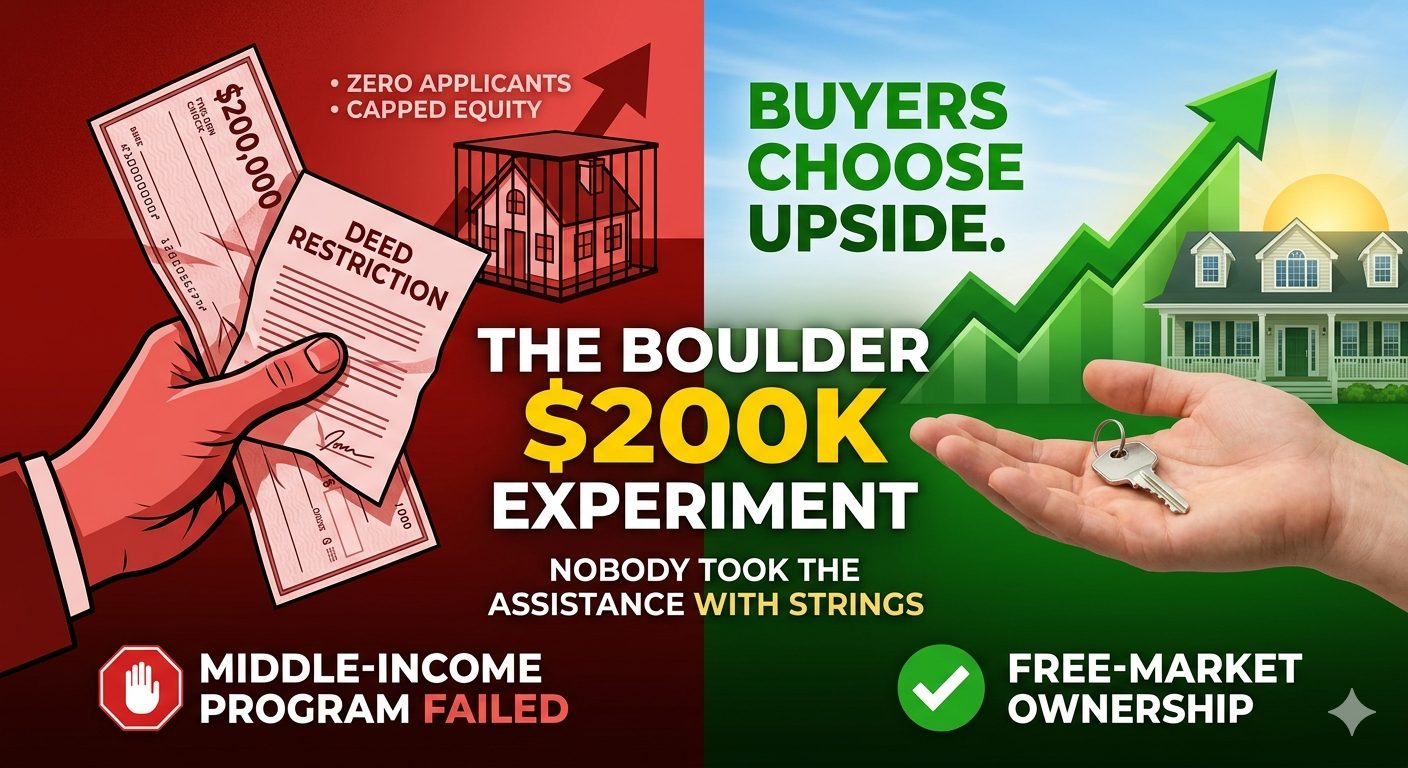
They offered buyers up to $200,000 in down payment assistance.
0% interest.
After nearly three years?
Not one person used it.
“Free” money, with a catch:
The program is called the Middle Income Down Payment Assistance (MIDPA) Pilot Program.
On paper, it sounds great:
Up to $200K in help
No interest
Designed for middle income buyers
But there’s a trade.
You take the money, and the city takes a piece of your future upside.
Your home comes with a deed restriction.
Your appreciation is capped.
Your future buyer pool is limited.
If you want to read the details straight from the city, here it is:
https://bouldercolorado.gov/guide/middle-income-down-payment-assistance-pilot-program
And here’s the kicker-after nearly three years, the program has produced zero applicants:
Boulder’s middle-income down payment program drew zero applicants. The city may end it.
What buyers actually said (without saying it)
Forget surveys. This is real behavior.
Even in one of the least affordable markets in the country…
buyers passed on “free” money.
Why?
Because they still want real equity.
Not shared equity.
Not capped equity.
Not a partnership with the city on their upside.
They’re willing to stretch on payment before they give that up.
That tells you everything.
At the same time…
Boulder is now looking at vacancy taxes:
Roughly ~$2,000/year (city concept)
Up to ~$7,000/year (citizen proposal)
Targeting homes sitting empty 6+ months
Translation:
If you’re a buyer → incentives come with strings
If you’re an owner → inactivity may get taxed
That’s not politics. That’s incentives.
The part nobody is saying out loud
We’re slowly splitting the market into two lanes:
Lane 1:
Free-market homes
→ full upside
→ full flexibility
Lane 2:
Assisted / restricted homes
→ easier entry
→ capped equity
And buyers are telling you, pretty clearly, which one they want.
What this means
If you own:
The value of being a clean, unrestricted asset may matter more going forward, not less.
If you’re buying:
Understand the trade. Lower payment today vs. capped upside later.
That’s not a small decision. That’s the whole game.
Bottom line
You can argue policy all day. But there’s an old economics axiom:
Money goes where it’ treated best.
Behavior is cleaner than opinions:
Boulder offered $200K to help people buy homes.
And buyers said:
“No thanks, we want the upside.”
If you want to talk through how this affects your specific situation, buying, selling, or holding, we can kick it around.
No politics. Just incentives, numbers, and outcomes.
